
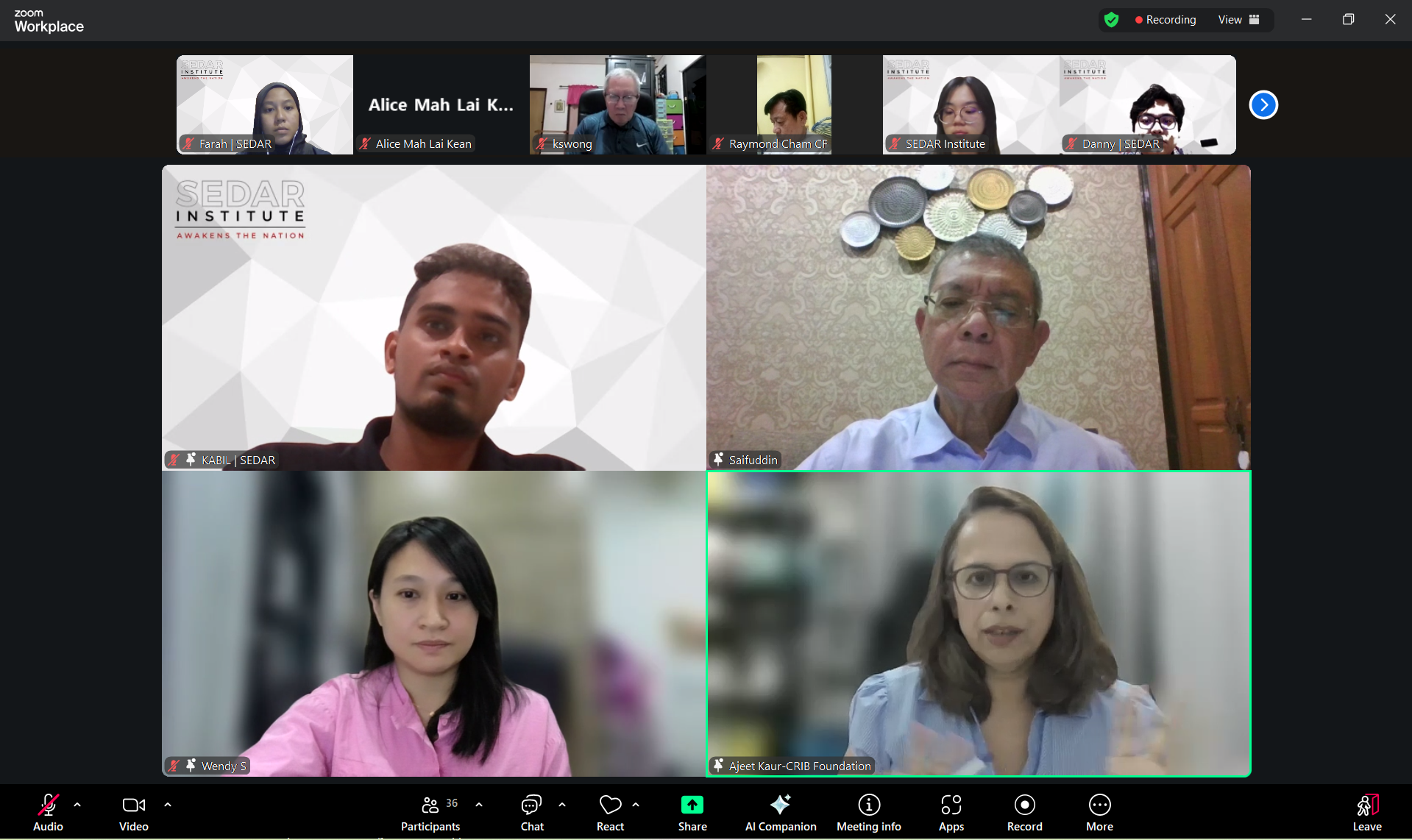
On 28 October 2025, SEDAR Institute hosted a Webinar entitled “Creating Safe Learning Space.” The event featured three distinguished panelists, Dato’ Sri Saifuddin Abdullah (The Parliamentary Spokesperson on Education for Perikatan Nasional), Sdri. Wendy Subramaniam (Information Chief for Parti Gerakan Rakyat Malaysia), and Sdri. Ajeet Kaur (Co-Chairperson of the Child Rights Innovation & Betterment Foundation). Sdr. Kabileshwaran Kalaiselvan, a researcher at SEDAR Institute moderated the webinar.
The discussion centred on the urgent issue of creating a safe school environment in Malaysia, following recent incidents of bullying, sexual assault, and violence among students. Key highlights include discussions on governance and accountability, education and social reform, along with digital and moral responsibility.
Panel Discussion Highlights
Governance and Accountability
Starting the discussion, the panelists agreed that Malaysia’s education system is experiencing a breakdown of trust, with parents fearing for their children’s safety amid rising cases. Saifuddin Abdullah and Wendy Subramaniam criticised the Ministry of Education (MOE) for its inadequate response and lack of urgency. Saifuddin Abdullah highlighted the imbalance in government spending with RM8 million for national flags versus RM4 million for CCTV, as a reflection of misplaced priorities.
He argued that the Ministry’s “business-as-usual” attitude during parliamentary debates over the Zara case in Sabah and other incidents revealed a failure of leadership. The speakers further emphasised that effective reform requires not only strong political will but also consistent policies and accountability mechanisms. Saifuddin Abdullah also proposed that schools be transformed into community hubs, allowing parents, alumni, and professionals to support educators through structured partnerships while maintaining proper safety protocols.
Education and Social Reform
Wendy Subramaniam argued that harmful gender norms and violence stem from early social conditioning where boys are taught to suppress emotions and equate dominance with strength, while girls are often silenced. Ajeet Kaur further explained that misogyny and bias are reinforced through media and cultural practices. Both agreed that schools must go beyond academic instruction to teach empathy, respect, and gender sensitivity.
Saifuddin Abdullah also highlighted the need to simplify the curriculum, reducing excessive subjects and content that burden both students and teachers. He proposed a more balanced evaluation ratio of 70:30 between academic and co-curricular learning, encouraging experiential learning through partnerships with civil society and professional bodies. Teachers’ overwhelming workload was also discussed, with participants noting that educators are often overextended by administrative duties, committee responsibilities, and strict performance indicators.
Wendy Subramaniam stressed that teachers should serve as early detectors of behavioural changes and as safe contact points for students, supported by stronger parent-teacher communication. On the topic of sex education, the panel agreed that reproductive health and safety education should be standardised across all school systems to address ignorance about consent and statutory laws. Ajeet Kaur emphasised the need for teacher training and age-appropriate materials, while Saifuddin Abdullah argued that such education must be grounded in adab (moral discipline) to instill ethical values alongside knowledge.
Digital and Moral Responsibility
Ajeet Kaur raised concerns about children’s early exposure to violent or sexualised content through online games and social media platforms. She argued that banning technology is not a solution. Instead, schools must cultivate digital literacy and responsible online conduct from an early age. Saifuddin Abdullah supported this view, proposing that the respected ministry work with agencies like CyberSecurity Malaysia to develop digital safety modules for teachers and parents. The panel also discussed potential regulations, such as social media age restrictions, but most agreed that education and awareness are more sustainable than outright bans.
Furthermore, Saifuddin Abdullah proposed implementing psychological and background checks for all adults working within school grounds, including canteen staff and cleaners, to strengthen school security comprehensively.
The conversation also touched on sensitive legal issues, particularly the misunderstanding of statutory rape laws. Ajeet Kaur criticised the minister of education, who used the term “sexual misconduct” to downplay serious offenses, emphasising that sexual crimes are acts of violence, not mistakes. She called for clearer legal education for students, explaining that minors under sixteen cannot legally consent and that children must be taught both boundaries and the law in accessible, age-appropriate ways.
Q&A Session
The Q&A session began with a discussion on the recent announcement that police officers would conduct inspections and spot checks in Melaka schools. Ajeet Kaur provided a legal perspective, emphasising that the police have no authority to inspect students’ mobile phones unless they are directly involved in an active investigation. Arbitrary inspections, she warned, would create fear and distrust toward law enforcement, potentially discouraging students from seeking help in genuine situations of danger. Ajeet Kaur recommended that schools engage trained counselors and child psychologists who are equipped to handle behavioral or disciplinary issues.
Saifuddin Abdullah supported this view, describing Malaysia’s tendency to respond impulsively to crises with ill-considered solutions. He likened the proposal to appointing ex-military personnel as school wardens, which he deemed inappropriate without proper training in child psychology and welfare. Saifuddin Abdullah also called for a re-evaluation of hostel policies, suggesting that the Ministry of Education review the suitable age for boarding students.
A participant then raised the issue of whether juvenile offenders should be punished or rehabilitated. In response, Ajeet Kaur explained that Malaysia’s legal system already provides mechanisms for rehabilitation through specialised institutions. Juvenile offenders sent to these centres are still entitled to education and can continue their studies while undergoing rehabilitation. She stressed that punishment should always include an educational component, as every child, regardless of their mistakes, retains the right to learn and reform. This approach emphasised guidance and reintegration rather than stigmatisation.
The discussion then moved to the last question of online safety and the technological challenges of preventing minors from faking their age to access inappropriate content. Ajeet Kaur explained that while most online platforms have age restrictions, these systems are easily bypassed. Implementing MyKad or MyKid verification might solve this technically, but it raises serious privacy concerns regarding who stores and manages such sensitive data. She argued that the most effective solution is still education and parental supervision for guiding digital behaviour and ensuring safe usage.
Disperse
The session concluded with the speakers agreeing that ensuring safety in schools requires more than surveillance or punishment. It demands education, empathy, and cooperation among teachers, parents, and policymakers to nurture a generation capable of empathy, respect, and critical awareness.



-300x200.jpg)

