
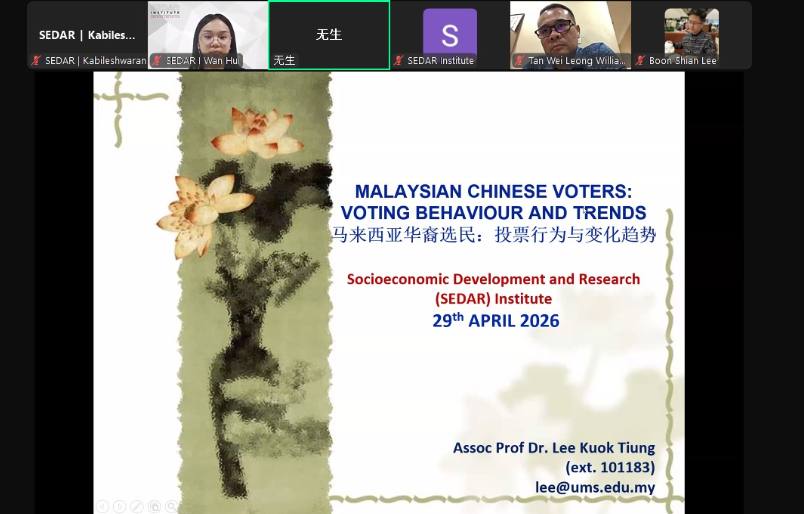
On 29 April 2026, SEDAR Institute hosted a webinar entitled “Malaysian Chinese Voters: Voting Behaviour and Trends,” delivered by Associate Professor Dr. Lee Kuok Tiung from the Faculty of Social Sciences and Humanities, Universiti Malaysia Sabah (UMS). The session examined the evolving dynamics of Malaysian Chinese electoral behaviour in the context of shifting political, economic, and demographic landscapes.
The presentation focused on the evolving dynamics of voting behaviour in Malaysia, particularly the growing importance of economic concerns, shifting regional priorities, and changing attitudes among younger voters following the implementation of UNDI18. It also highlighted the strategic implications for political parties, emphasising the need to respond to issue-based expectations, strengthen local engagement, and rebuild trust among an increasingly discerning electorate.
Presentation Highlights
Evolving Dynamics of Voting Behaviour
The session focused on the evolving dynamics of voting behaviour in Malaysia, particularly the shift away from traditional bloc voting, the growing importance of economic concerns, and the increasing influence of regional priorities, especially in East Malaysia, as well as the impact of younger voters following the implementation of UNDI18. It also highlighted the strategic implications for political parties, emphasising the need to respond to issue-based expectations, strengthen local engagement, and rebuild trust among an increasingly discerning electorate. Highlighting the Chinese voters, Dr.Lee also said that the Chinese voters are no longer ‘Silent Supporters’. If a party does not offer a product that protects their pocketbook and identity, they will straightly “walk out of the store”.
Economic Pragmatism and Issue-Based Voting
The speaker emphasised that voters are increasingly influenced by “bread-and-butter” issues, including the rising cost of living, subsidy rationalisation, and pressures faced by the middle-class voters and small businesses. This shift reflects a broader transition toward evaluating political actors based on governance performance and policy outcomes rather than identity or ideology. At the same time, voters’ dissatisfaction with the pace of reforms and perceived compromises within governing coalitions has contributed to political fatigue. Rather than translating into support for opposition parties, this discontent might be expressed through abstention among Chinese voters in the upcoming election, signalling a deeper crisis of confidence in available political choices.
Implications for Electoral Strategy and Future Political Competition
The speaker emphasised that changing voter arithmetic limits the effectiveness of ethnic-based electoral strategies. Concurrently, the rise of regionalism, particularly in Sabah and Sarawak, reflects growing support for local parties perceived as better representatives of state interests. These developments, combined with increasing voter disengagement, create both challenges and opportunities for politicians. Parties need to position themselves as a “Moderate Economic Shield”, by shifting from reliance on broad ideological narratives to a multistrategy approach, focusing on local relevance, economic interest, policy delivery, and also addressing the needs of disenchanted voters who remain politically detached.
Q&A Session
During the Q&A session, participants raised broader questions on Malaysia’s evolving political landscape. These included whether a long-standing “multicultural” political positioning may face challenges in a more polarised environment and how such a party might need to recalibrate or redefine its political role to remain relevant. Speaking from the perspective of Chinese-based parties, Dr. Lee highlighted that with the declining Chinese population in Malaysia, these parties will eventually need to adopt a more multiethnic approach to engage voters.
The discussion also explored the impact of the increasingly open information environment on political engagement, questioning whether greater access to information enhances voter participation or instead contributes to information overload and political disengagement. Dr. Lee warned that the content shown on digital platforms, especially social media, are always personalised based on the algorithm. This will create a false sense that certain information or opinions are more prevalent, even when they may not reflect the broader public view.
The speaker was asked about Sabah’s role as a “laboratory” of political change, particularly on whether its voting trends are unique to the state or potentially replicable in Peninsular Malaysia. Dr. Lee said the recent emergence of local party sentiments in Sabah appears to be influenced by developments in its neighbouring state, Sarawak. Regional parties in Sabah have replicated Sarawak’s political narrative, emphasising local issues such as MA63. However, this dynamic is less likely to be replicated in Peninsular Malaysia, where political sentiments are different. But he also highlighted that, for Chinese voters, bread-and-butter issues will always remain as a key priority, and political parties must effectively address these concerns while also navigating local sentiments.
Disperse
In conclusion, the webinar underscores that the Chinese voters are increasingly pragmatic, prioritising economic issues and governance outcomes while distancing themselves from traditional political alignments. For political parties, this necessitates a fundamental strategic shift toward policy effectiveness, local responsiveness, and trust-building. As Malaysia approaches its next general election, the ability of political parties to adapt to these evolving expectations will be decisive in shaping their electoral success.