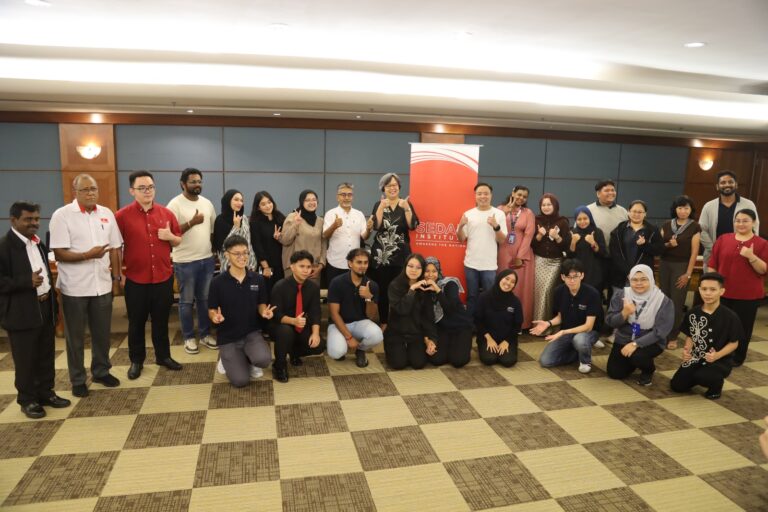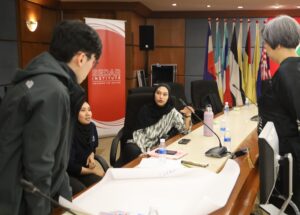
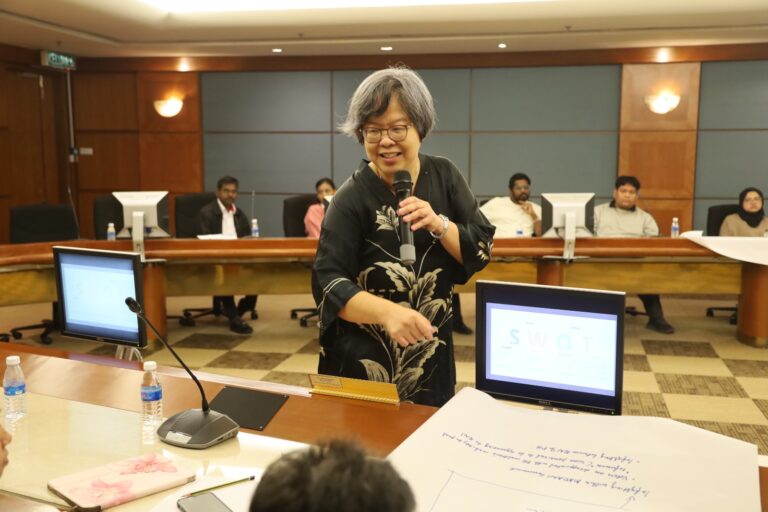
On 11 September 2026, SEDAR Institute hosted a workshop titled “Winning the Digital Battlefield: Decoding Modern Political Communication Skills,” conducted by Dr. Pauline Leong Pooi Yin, who is the Head of the School of Communication and Media Studies at Sunway University. Bringing together political leaders, think tank researchers, and college students, the session delved into the mechanisms of political communication and offered practical frameworks for conducting impact-driven public engagement.
The workshop was divided into two parts, starting with an introductory session on the fundamentals of political communication and leading into an interactive group discussion. The introductory session explored the history, concept, and mechanisms of political campaigning, highlighting case studies of successful precedents. The interactive session shifted to a hands-on group project, where participants were grouped to identify the political strengths and challenges and design public engagement strategies that amplify the key strengths.
Introductory Session: Political Communication 101
Dr. Pauline first introduced the participants to the basic concept of political communication, emphasising that the primary goal of political communication is to persuade citizens to support specific political actors. Dr. Pauline then provided a brief history of political communication, highlighting how technological evolutions have shaped political messaging in different eras, such as the current trend of using short reels to attract young voters. While technological advances create opportunities, she cautioned that they also introduce serious threats, such as cybertroopers leveraging AI to spread fake news.
Dr. Pauline also explained the difference between political public relations (PR) and advertising: the former focuses on building trust, while the latter is to push specific messages to broad audiences. Through the example of Najib Razak, Khairy Jamaluddin, and Syed Saddiq, Dr. Pauline emphasised the importance of political PR because it will affect the audience’s perception of the subject. While on political advertising, she cited Dwight D. Eisenhower’s successful political advertising in the United States presidential election. Those campaign videos portrayed the ideal vision of the country by utilising the television ad break time; some of the videos also made the campaign catchy and easy to understand. She also used examples in Malaysia, where popular culture is incorporated into political advertising. These elements provided the participants with a basic understanding of political communication, which equipped them to utilise those concepts in the following interactive session.
Interactive Session: SWOT Analysis
The second part of the workshop provides the participants with an opportunity to examine what they learned from the previous session. Dr. Pauline then divided the participants into groups to conduct a SWOT (strengths, weaknesses, opportunities, and threats) analysis on different political entities in Malaysia. Based on the analysis, each group then created a strategic communication campaign designed to maximise strengths, minimise weaknesses, capitalise on the opportunities, and neutralise the potential threats.
Disperse
Before concluding the workshop, Dr. Pauline opened the floor for a Q&A session. Some pointed out the failures of political communication that trigger political downfall; some touched upon the importance of political communication on both grassroots and social media. In the end, all participants agreed that this fruitful workshop equipped them not only with a clear understanding of political communication, but also with practical insights on leveraging strengths in media strategies and looking at political messaging through a different lens.